

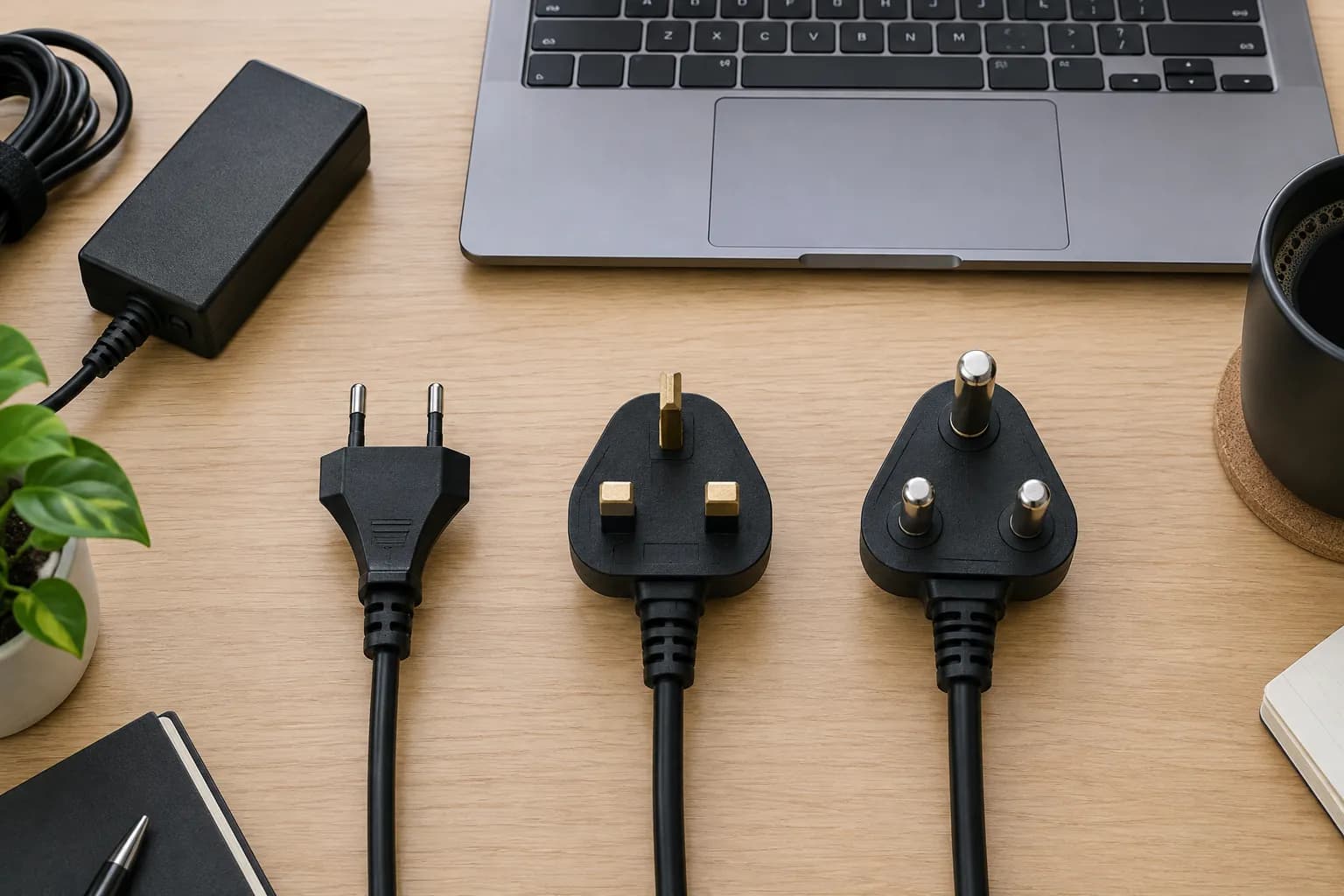
Laptop chargers almost all accept 100 to 240 volts, so what changes between countries is the mains cord or plug head, and matching it to the local socket (Type G across much of anglophone Africa, Types C and E across francophone Africa, Types M and N in South Africa) is cheap when planned before shipping. Getting it wrong means every user needs a travel adapter on day one.
What are the parts of a laptop charger?
A typical laptop charger has three parts. The power brick converts mains electricity to the low voltage the laptop needs. The DC cable runs from the brick to the laptop and ends in a connector specific to the laptop (a barrel, a slim tip, MagSafe, Surface Connect or USB-C). The mains cord runs from the wall to the brick. On most business laptops, the mains cord plugs into the brick with a C5 cloverleaf or C7 figure-eight connector, so it can be swapped without touching the rest.
Smaller USB-C adapters often plug straight into the wall. Some have interchangeable plug heads; others have a fixed plug and must be bought in the right regional version.
Check the adapter label first
The adapter label lists input and output. Look for an input line such as "100-240V ~ 50-60Hz". If it is there, the adapter will work on any African grid, and only the plug needs attention. The output line shows voltage and current or wattage, which matters when substituting chargers between models.
Which sockets are used in each country?
| Country | Common socket types | Cord to fit |
|---|---|---|
| Nigeria | G, D | Type G (UK) |
| Ghana | G, D | Type G (UK) |
| Kenya | G | Type G (UK) |
| Uganda | G | Type G (UK) |
| Tanzania | G, D | Type G (UK) |
| Rwanda | C, J | Type C (Euro) |
| Ethiopia | C, E, F, L | Type C or E/F (Euro) |
| South Africa | M, N, C, D | Type M, or N for newer installations |
| Zambia | G, C, D | Type G (UK) |
| Senegal | C, D, E, K | Type C or E (Euro) |
| Côte d'Ivoire | C, E | Type C or E (Euro) |
| Cameroon | C, E | Type C or E (Euro) |
| DR Congo | C, D, E | Type C or E (Euro) |
| Egypt | C, F | Type C or F (Euro) |
| Morocco | C, E | Type C or E (Euro) |
| United Arab Emirates | G (C, D in older buildings) | Type G (UK) |
A Type C (two round pins, Euro) plug fits Type C, E and F sockets, which makes it a safe default across francophone and North Africa. In South Africa, the old three-round-pin Type M is still the most common socket, while the newer Type N appears in recent installations.
Laptop-side connectors by family
- Dell: USB-C on recent Latitude and Precision models; round barrel connectors on older generations.
- HP: USB-C on recent EliteBook and ProBook models; the 4.5 mm blue-tip barrel on older ones.
- Lenovo: USB-C on current ThinkPads; the rectangular slim tip on older models.
- Apple: USB-C on all Apple silicon MacBooks, with MagSafe 3 on recent models.
- Microsoft Surface: Surface Connect on older models, USB-C charging on recent ones.
- Rugged and workstation laptops: often high-wattage barrel adapters specific to the model.
Why wattage matters
USB-C made chargers more interchangeable, but wattage still matters. An ultrabook may run on 45 W, a mainstream business laptop on 65 W, and a mobile workstation on 130 W or more. A smaller adapter may charge slowly, fail to charge under load or cause the laptop to throttle. For fleets, standardising on one wattage that covers every model simplifies spares.
Grey-market and counterfeit chargers
Counterfeit laptop chargers circulate widely. They may look identical to originals but skip safety components, overheat or fail on unstable power. In markets with generator switching and voltage spikes, a poor charger can damage the laptop. Ask for original or documented chargers, check safety markings against the manufacturer's documentation, and pair laptops with surge protection where the power is unreliable.
How to specify power in a laptop order
- State the destination country and the socket type end users have.
- Ask for the mains cord or plug head to match, so no adapters are needed.
- Confirm whether each unit includes an original, generic or no charger.
- List the connector type per model line, especially in mixed lots.
- For fleets, add spare chargers and consider one wattage for all models.
Generators, surges and backup power
In many African cities, laptops charge from a mix of grid power, generators and inverters. Switching between sources can produce spikes and dips that a well-made adapter handles and a cheap one does not. Inverters with modified sine-wave output can also make some adapters run hot or buzz. For offices, surge-protected power strips are a minimum, and a line-interactive or online UPS on key desks protects both laptops and docks. For resellers, explaining this to customers reduces returns that are blamed on the laptop but caused by the power.
Chargers in refurbished lots
Refurbished lots handle chargers in three ways: original adapters tested with each unit, generic replacement adapters, or no chargers at all. Each is legitimate if stated. Original adapters are worth more but may come with a mix of connector types in a mixed-generation lot. Generic adapters vary widely in quality, so ask about their source and safety markings. Lots without chargers need adapters sourced separately, and the cost belongs in your comparison.
Related reading
- Laptop chargers, docks and bags- Accessories sourced with your laptops
- Laptop keyboard layouts for African markets- The other per-country detail
- Laptop supplier for Africa- Country-level matching
- Power and UPS- Category overview on fctrading.co
- UPS sizing and plugs- Power guides at Computer Hardware Wholesale
Related reading


Leave a Comment
Your email address will not be published.